Tang receives fellowship to explore mitochondrial therapy for vascular injury
Fang Tang, a postdoctoral researcher in QSI RENU member Bin Jiang’s laboratory, was recently awarded a two-year fellowship from the American Heart Association to investigate the use of engineered mitochondrial transplantation to treat vascular injury. In this interview, Tang explains her proposed project, shares what she enjoys most about science, and describes her experience of working in the Jiang group.
How would you summarize your AHA fellowship project?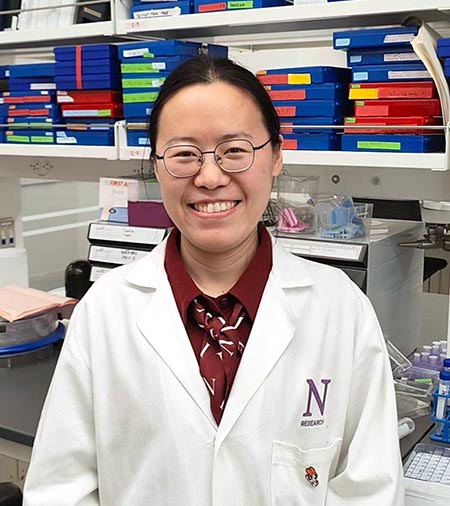
Our project is focused on vascular injuries after the implantation of stents, which are tiny tubes used to open blocked blood vessels. There are some strategies that have some effect in mitigating these injuries, like drug-eluting stents, but those are not directly focused on the pathology or the cell injury itself.
We have this idea to use mitochondria, which are the organelles responsible for producing the energy cells need to function. We want to isolate mitochondria from healthy tissue or healthy cells and then transplant them to this injured place.
We have developed a strategy to attach these mitochondria on the surface of stents, and then once the stents are placed in an artery, the mitochondria will enter the injured cells. This is some of the preliminary work that we have already completed, but we want to keep optimizing it because we think these transplanted mitochondria can help with this at-risk oxidative environment that typically occurs after stents are implanted.
How close do you think this work is to being potentially available for use in patients?
I think it would still be considered early-stage research for the medical application. Additional preclinical studies and collaboration with clinicians will be needed before clinical trials can begin.
However, we have a different goal for the commercial translation of this research. We can make this a sort of mitochondrial resource and transfer our technology for other laboratories to use. For example, we could develop standardized mitochondrial preparation kits or services that allow researchers to access functional mitochondria without having to isolate them themselves.
What inspired you to pursue a career as a scientist?
My background is in chemistry. I’m not originally trained in biology or biomedical engineering but one thing that motivated me is to explore something that’s unknown. Progress can be slow when working in a new or challenging area, but it’s always exciting.
The reason I transferred from chemistry to a biomedical engineering focus with RENU is that I want to apply my knowledge for a real-life medical or engineering application. I want to connect these different fields in a way that is useful, and I’m very passionate about that process.
What are you most proud of in your research career so far?
Sometimes when you design an experiment, you doubt yourself on whether the experiment can really test your hypothesis. But when you get that feeling of, “Oh, this really worked!”, it’s extremely exciting and motivates you to take the next step.
Every small step is worth celebrating and being proud of. Of course, there are big awards or publications that are also very exciting, but those are just the result of the work. The research itself is rewarding, and I enjoy working with all my collaborators and everyone else who supports me.
How would you describe the environment of the Jiang lab?
I feel very supported here and Dr. Jiang is a great leader. She sets an example for the team, and when you work with her you feel you can really trust her.
Our lab has very good systems for managing our data, our safety, and our relationships with collaborators. The lab is very organized, which makes it much easier to be productive.
What are your hobbies outside of research?
I like to hike and walk outside to clear my head. Chicago is beautiful and when you walk the streets, you feel like you are connected to the history of this city. When the weather’s nice, I also like to take short drives outside of the city and find some walking trails with lakes and other scenery.