Meet the Researchers: Nayoung Kim
Nayoung Kim will join Northwestern on July 1 as a QSI RENU Postdoctoral Fellow, co-advised by Nathan Gianneschi and Kurt Lu. She recently defended her PhD in Chemistry at the Korea Advanced Institute of Science and Technology (KAIST). In this interview, Kim explains how her current research connects to the work she plans to do at Northwestern, how making tofu sparked her interest in science, and how toying with different aspects of material design can enhance functionality.
Can you tell me about your research background?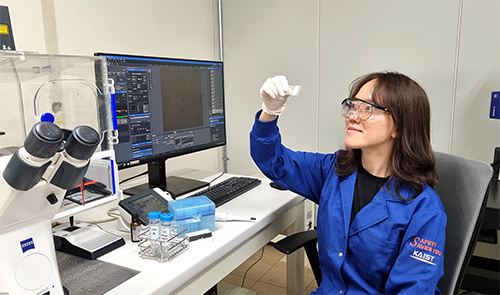
My PhD research is similar to making a cell version of Ironman. With Ironman, there’s a man inside the suit, and the suit protects the man from external stressors while also providing him with various functionalities. I do the same thing with living cells.
I make a nanometer-thick shell that protects the cells inside from different stressors, and I can also give cells new functions by diversifying the materials used for making the shells and attaching functional moieties such as enzymes onto the shells. The materials I use for making the shells are usually polydopamine, which is known as a synthetic melanin. This is the shared interest between my group at KAIST and Professor Gianneschi’s group.
I was really interested in the pathways to synthesize melanin because, in nature, melanins serve diverse functions in living organisms. For example, they scavenge highly reactive molecules called “radicals” that can damage cells, protect against UV radiation, and they sometimes chelate metal ions. Since various enzymes and precursors are utilized for making melanin in nature, I wanted to mimic this process by using enzymes in my own synthesis.
As I explored this field, I came across Professor Gianneschi’s group which also studies melanin in great depth. While my research has focused heavily on enzyme-mediated synthesis, they extensively utilize chemical oxidant-mediated strategies, in addition to enzyme-based approaches, to explore many different functions of melanin, including biomedical applications. I became really interested in this complementary perspective.
What applications are you planning to explore here during your fellowship?
The general topic is synthesizing melanin and applying it to wound healing. Synthetic melanin can be applied to wound healing because it acts as a radical scavenger.
When we get injured, reactive oxygen species (ROS) are required for healing because they serve as the antimicrobial defense as well as signaling molecules during the healing process. However, if this ROS generation becomes excessive and persistent, the initial balance breaks and it will lead to chronic inflammation. Synthetic melanin is useful to apply here because it scavenges the excess ROS and brings the wound healing back into balance.
So, I’d like to first synthesize the melanins and explore how different factors affect their performance. For example, we can change the precursors used, the structure and surface area of the materials, and also the surface chemistry.
The post-functionalization is interesting because it can tune how the material interacts with human tissue. Also, the precursors and synthetic protocols themselves determine a lot of the features of the resulting materials, so by altering those it may be possible to synthesize melanins with enhanced healing capacity.
How did you become interested in science in general, and what led you to this chemistry track that you’re currently on?
Going back to when I was young, I really liked to do experiments because then I could turn the knowledge in the textbooks into “the real thing.” When I was 11 years old, I learned how to make tofu by adding magnesium chloride solution to soy milk. The two coagulated together into a solid, and it became real tofu.
From that moment, I became curious about interesting phenomena and wanted to test them through experiments. I think chemistry is one of the fields where we can really test ideas through hands-on experiments.
What are your hobbies outside of research?
I really love listening to music and I sometimes go to music festivals with my friends to see live bands. I’m kind of a rock person — not really hard rock, but lighter rock.