Meet the Researchers: John Soukar
John Soukar recently defended his PhD in Genetics and Genomics from Texas A&M University and is one of two inaugural recipients of the QSI RENU Postdoctoral Fellowship of Excellence in Translational Regenerative Engineering. In this interview, Soukar explains his research on mitochondrial therapeutics and what attracted him to the fellowship, which he will carry out under the co-mentorship of QSI RENU members Bin Jiang and Mark Eskandari.
Can you give an overview, in layman’s terms, of the research you plan to pursue?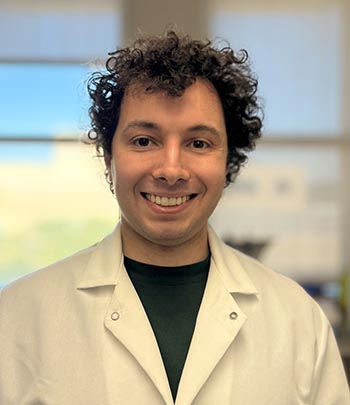
Your mitochondria produce your energy for your cells, so high-energy tissues and organs need a lot of mitochondria. With your heart or muscles, for example, you need a lot of energy to do your daily activities.
Many diseases are attributed to some type of mitochondrial dysfunction or mitochondrial damage. You could have a genetic mutation that causes damage to your mitochondria, causing them not to function properly, or you could have damage caused by some side effect of other pharmaceuticals.
Using mitochondria as a therapeutic is a way to replace dysfunctional mitochondria. In our lab at Texas A&M led by Dr. Akhilesh Gaharwar, we refer to it like replacing batteries in a phone, and you can do this a number of ways. You can isolate mitochondria from a patient’s own tissues or from cells in the lab and then give them back to the patient, or you can use stem cells to donate their mitochondria. Instead of putting a bandage on the wound, you’re just replacing the energy source for these cells.
What people have found in this field, including my lab and Professor Jiang’s lab, is that cells can uptake these mitochondria and incorporate them into their existing networks to help them recover their energy production and function.
What attracted you to this fellowship opportunity, and to working under your co-advisors Bin Jiang and Mark Eskandari?
The idea of using mitochondria as therapeutics was something I stumbled across in my PhD and then it became my thesis. So, when I graduated, I really wanted to continue this work.
I came across Professor Jiang’s profile while researching the field and she focuses on mitochondrial transplantation as a therapeutic, using isolated mitochondria rather than cells — a lot of the same stuff I’m interested in. I reached out to her as I was sending out job applications for both academic and industry jobs, and we sat down for about an hour, just chatting about the field, and she spoke to me about the fellowship and encouraged me to apply.
It was a really good fit because we both have similar interests and goals for the potential of this technology, and my expertise can hopefully contribute to her lab.
Did Professor Jiang suggest Dr. Eskandari as a good option for your co-advisor for this fellowship?
Yes, that was her suggestion. When she explained more about how this fellowship works — how you’re a little bit more independent and have two advisors to facilitate the commercialization and actual application of your research, that was more attractive to me than a traditional postdoc position.
She recommended Dr. Eskandari for his close collaboration with her and his insight into the clinical aspects of our research. I’ve talked to him a little bit, and we’ve developed a team to work on this aspect of mitochondria as therapeutics. We have a lot of experts in their respective fields, so hopefully we can come up with something that can be developed into a real product.
How does your QSI RENU project relate to what you worked on during your PhD?
It’s an extension of the work I’ve done but it’s somewhat tangential. There are two different approaches being explored: one is mitochondrial transfer, which is a cell-to-cell process and what I worked on in my thesis. The other is mitochondrial transplantation, where isolated mitochondria are administered like a biologic therapy, and that’s what Dr. Jiang works on.
I’m going to be shifting toward the transplantation side but also working much more on the commercialization aspect of it. We really want to work on how we can package these mitochondria, develop the storage processes and all the clinical aspects of how we can actually use them as therapeutics.
As you’ve said, anything that needs to be “powered” within the body needs mitochondria. Does that mean the applications for this work are very broad? What do you think are some of the test cases or potential applications?
The applications can extend to many common diseases. Almost any organ in your body can succumb to some kind of mitochondrial damage, and even in aging you lose mitochondrial numbers and your energy goes down. You can think of it as just replenishing this energy-generating machinery in your cells.
Dr. Jiang works on vascular diseases, but I’ve explored things like off-target drug effects. If you have cancer, for example, a lot of chemotherapies cause damage to other organs in your body, and that can also affect your mitochondria in those organs. In my thesis, I showed that mitochondrial transfer can repair some of the damage caused by chemotherapeutics.
Other research has shown promising outcomes for heart attacks, fibrosis or lung damage. All these organs in your body can benefit from either transplanting or providing new mitochondria to these systems. So, the applications are really broad, and you can use it for almost anything. The field is growing rapidly, and people are exploring this for a whole host of diseases.
What are your hobbies outside of research?
My girlfriend and I have two dogs, so we do a lot for them. I also like to go to the gym, we do a lot of climbing, and we’ve recently taken up camping. Our goal is to occasionally take some road trips across the Midwest.