Meet the Researchers: Jamin Lee
Jamin Lee is one of two inaugural recipients of the QSI RENU Postdoctoral Fellowship of Excellence in Translational Regenerative Engineering. She graduated with a PhD in Neuroscience from Seoul National University before transitioning to a postdoctoral position at Northwestern. In this interview, Lee describes the research she plans to pursue during her fellowship, as well as her affinity for interdisciplinary science.
How would you describe your research to a nonscientist?
The way I usually explain it to my friends is that we have organoids, which are small organ-like tissues made up of stem cells, and then we implant them into injured sites or areas where there’s a neural disconnection.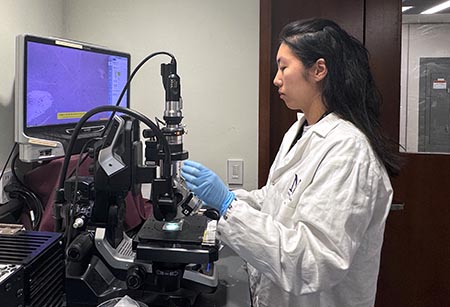
For example, something that we’re specifically targeting is spinal cord injuries. Many of these patients have their phrenic nerve severed and so we insert that blob of stem cells, called an organoid, right into the injury site. These organoids contain a lot of neurons, and over time the axons can grow out and recreate those connections.
Can you explain a bit more about this specific application with the phrenic nerve and why it’s important?
Phrenic nerves connect your diaphragm with everything above it, heading toward the brain. If a phrenic nerve is injured, you’re unable to function your diaphragm and require a ventilator to breathe. Only a very low percentage of patients are able to recover from this.
There are surgical techniques to rewire the nerves, but that approach has its limits in terms of the regenerative time that is necessary for those nerve-to-nerve connections to occur. There are also some FDA-approved cell therapeutics, but you have a very limited number of neurons that you can insert at the same time with that strategy.
In organoids, you have millions of cells, or more, and they are very localized, so you could potentially insert these organoids as a therapeutic to provide a substantial number of neurons to the area of interest, with less risk of them migrating to other regions.
What did you work on for your PhD research and how does that relate to what you expect to do at QSI RENU under your co-advisors, John Rogers and Colin Franz?
For my PhD, I did a lot of nanotech and electrophysiology of single neurons. Although my degree says “Neuroscience” it was technically an Interdisciplinary Neuroscience Program, and both my advisor (Gyu-Chul Yi) and I come from physics backgrounds.
I took a visiting predoctoral year with Professor Rogers’ group beginning in January of 2024, and we ended up extending that for another six months. During my time in the Rogers group, I started to work on microfluidics and integrating them with organoids. With that project finishing up, Professor Franz — who was already our collaborator — suggested that we try this new project and transition to in vivo studies.
What I’m working on now is quite different than what I did during most of my PhD research, but it’s an extension of what I started working on in my visiting year in the Rogers lab.
What are your ultimate goals in science?
I’d like to run my own academic lab and find my little mark in science and neuroscience. When the time comes and I have a few papers out, then I’ll try to naturally find my niche, but I would still like to stay with some basic science efforts and not completely lose my roots as a physics person.
I talk about this a lot with my parents, who are both professors, and I think it would be really exciting if we end up working together and founding our own nonprofit one day that can serve communities in need through science.
It sounds like you’ve worked on neuroscience, physics, and engineering, perhaps some other fields. What has your experience been like merging all those disciplines? Do some parts of the work come more easily to you than others?
It’s definitely a lot of fun because you are constantly learning new things, and being in an interdisciplinary situation gives you more insight.
My PhD advisor naturally trained me to think of different aspects of projects combining nanomaterials and biology. The experience of communicating with collaborator PIs in a completely different discipline at an early stage of my career really helped me learn how to plan more impactful projects.
It has also taught me flexibility in terms of developing new skills. Whatever fabrication I did in my PhD lab is completely different to the fabrication methods I need to use for microfluidics, which I ended up learning from a senior postdoc during my visiting year in the Rogers lab. At this point, I think I’m just used to working on interdisciplinary projects, and I have a lot of fun doing that.
What are your hobbies outside of research?
I watch a lot of Netflix, if you consider that a hobby. I can give anyone a good recommendation. I also like walking around the city and trying out new places, going to farmers markets and local cafes.