Meet the Researchers: El Hadji Arona Mbaye
El Hadji Arona Mbaye is a PhD candidate in the Department of Biomedical Engineering and a researcher in QSI RENU member Jacqueline Burke’s laboratory. In this interview, Mbaye discusses his work on type 1 diabetes, how he became interested in immunoengineering, and his excitement for the upcoming FIFA World Cup.
How would you describe your research to a nonscientist?
The goal of my research is to develop better immunotherapies to make islet transplantation a viable option for patients with type 1 diabetes. Islets are clusters of cells that help control blood sugar levels, and they can be transplanted to patients with type 1 diabetes who have lost their islets after an autoimmune attack. Those patients usually must take lifelong immunosuppressant drugs, which leaves them susceptible to a lot of different side effects and opportunistic infections.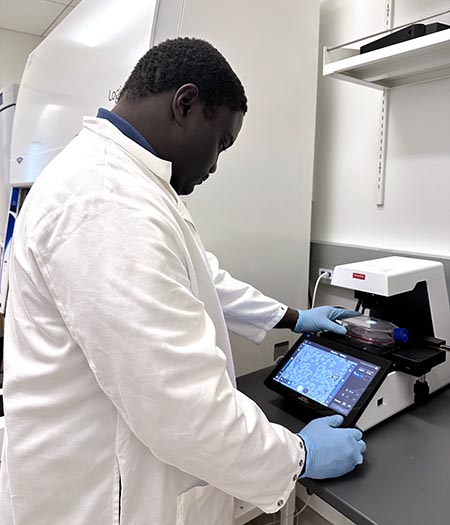
My work centers around making therapies, using nanoparticles, that can change how the immune system behaves. That way, when you get the transplant, you don’t reject it. But we also want to make sure that the immune system isn’t completely shut down, so it can respond to other infections or pathogens that you might encounter. We’re trying to find this fine balance, which we call “specific tolerance.”
I’m currently studying two different nanoparticles, and each one is aimed at solving different problems that happen after islet transplantation. One arm of my research studies how an antibiotic-resistant skin infection called MRSA impacts tolerance for accepting the islet graft following treatment with rapamycin-loaded nanoparticles.
The other part focuses on a nanoparticle containing vitamin D, where we’re using the multifaceted abilities of vitamin D when it comes to inflammation, oxidation, and coagulation. What we’re trying to do there is stop this early innate immune reaction that happens when islets are transplanted in the liver.
How far along is this research? Is it at more of an exploratory stage or is it getting closer to clinical use?
The first project, with the rapamycin-loaded polymersomes, is something that Dr. Burke started in the lab and she is currently looking into translating that for different applications, including delaying the onset of type 1 diabetes. The other project with vitamin D is still at an early stage, but we’re starting to get some exciting proof-of-concept results.
Transplant recipients usually need to take lots of different drugs because the immune system is complex and there are a lot of things to balance. So, I think there is a link between these two projects, because the two nanoparticle platforms could potentially be used as a combination therapy for islet transplant patients.
How did you become interested in biomedical engineering, and what eventually led you to focus on type 1 diabetes?
I was always fascinated by science. I really like chemistry, so at first I thought I might be more of a chemical engineer or something like that, but I also had a love for biology and wanted to find a way to make a broad impact for patients.
As far as my current research area, it started as more of an interest in immunology instead of diabetes. I was an undergrad during the COVID pandemic, and like most people, I stayed at home and really had a lot of time to think. During this time, I started to get more and more interested in immunology, how complicated the immune system is, and how we can play with it to get certain outcomes.
That was really exciting to me and that’s what attracted me to this project. Immunomodulation is challenging in the context of type 1 diabetes, but there is an opportunity to make a big impact.
In the future, I hope to stay in this field of immunotherapies. I’m not set on staying in diabetes treatments, because I’m also interested in tolerogenic vaccine development for other autoimmune diseases and treating infectious diseases that are prevalent.
I’m from Senegal, so I’m also thinking about how the therapies I’m working on can be accessible in other countries and to as many people as possible. For example, our formulation is administered subcutaneously, so it’s easy for a patient to inject at home. They would not have to go potentially far away to a clinical center. It’s important to consider all these details when developing a therapy.
You received a Teaching Assistant award last year from the Biomedical Engineering department. What did it mean to you to be recognized in this way?
Teaching is a part of the academic world that I really enjoy. I was a TA for this biotransport class, which is arguably one of the most challenging courses in the BME department. I was the sole TA for about 50 students and because it’s such a tough class, students rely a lot on the TA.
It was a very rewarding experience because everyone comes out of that class feeling like they learned quite a lot, so it was nice to be recognized by the department. Right now, I’m pursuing a teaching certificate with the Searle Center, because I want to consider an adjunct teaching position in the future.
At this point in my training, I see myself as most likely going to work in the pharmaceutical industry after graduation, but I would really want to accompany that with an adjunct faculty position that allows me to teach about what I do in the industry, the biotech world, and the transition. I think that’s a good compromise, because I really like research but also like the aspect of teaching and mentoring the next generation of students.
What are some of your hobbies outside of school and research?
I like to play and watch soccer. My favorite club team is Real Madrid, so I always catch some of their games, and I’m really excited about the World Cup as well. I hope Senegal goes far!
I’m actually going to the friendly match between Senegal and the U.S. in Charlotte at the end of the month. The tickets are not as expensive and I have some family there, so I am really looking forward to it. It’s not the World Cup, but at least I can say I saw my national team play live.